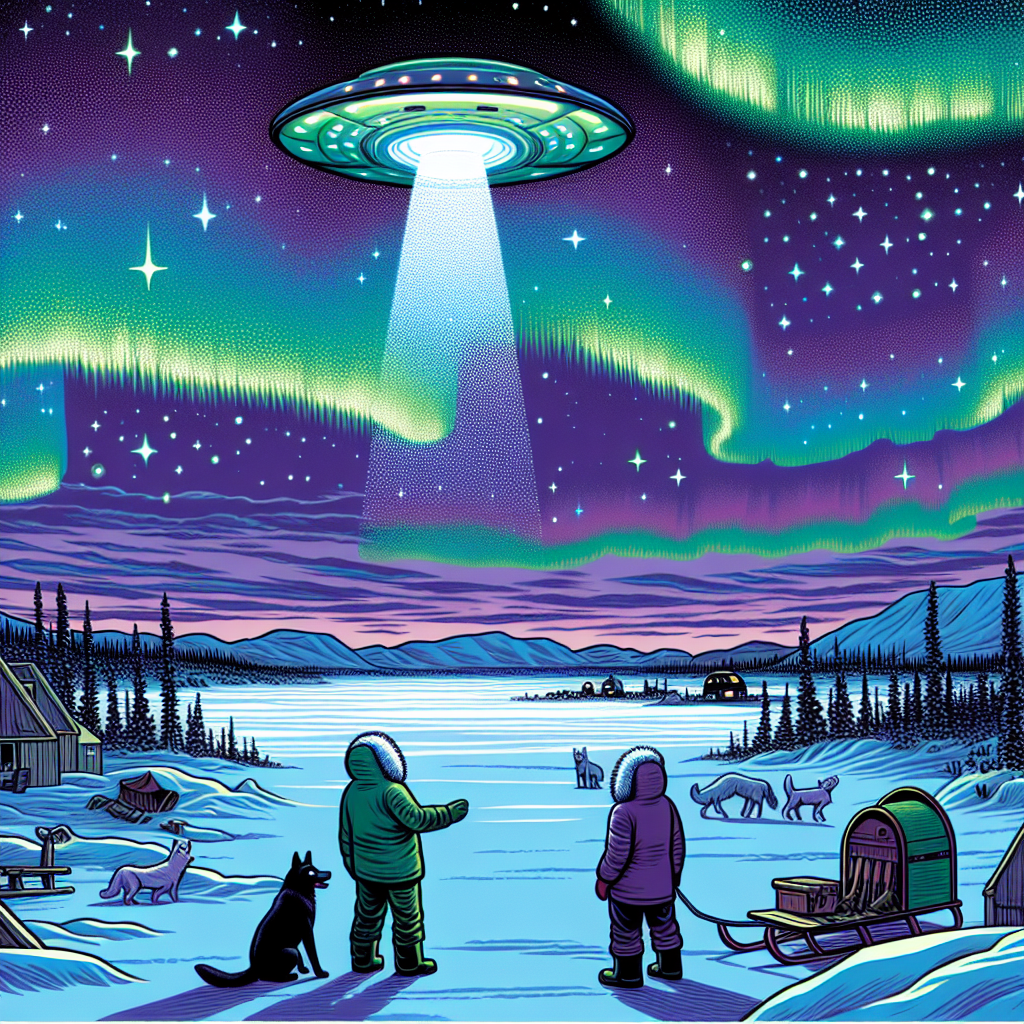
Introduction to UFO Sightings in the Canadian North
The northern realms of Canada, known for their breathtaking beauty and sparse population, have been at the center of numerous UFO sightings over the past century. These reports, often shared by locals and travelers alike, encompass a diverse range of phenomena observed across the Arctic and Subarctic regions. The remote locations, coupled with long, dark winters, provide a prime stage for mysterious activities in the night sky, making it a perfect setting for UFO enthusiasts and researchers.
The reports often include mysterious lights, unidentifiable flying objects, and sometimes even sounds with no clear origin. Communities like Yellowknife in the Northwest Territories, Whitehorse in the Yukon, and various Inuit settlements have all contributed their own unique accounts. But what makes these sightings particularly intriguing is their consistency over time and geography.
<
Early Sightings: Indigenous Accounts
Indigenous communities have inhabited these regions for thousands of years and have their own rich oral histories that sometimes mention unexplained aerial phenomena. Traditional stories from the Inuit, for example, describe bright, moving lights in the sky, known as 'Aqsarniit'—also related to the Northern Lights but sometimes imbued with different characteristics suggestive of something more 'structured.'
These accounts are often intertwined with spiritual beliefs and the natural environment, describing lights that dance across the sky in ways that differ from the well-known auroras. According to some Elders, the lights are sometimes accompanied by shapes and sounds that do not fit the usual celestial phenomena narrative, indicating the possibility of early UFO encounters.
Post-War UFO Sightings
Following World War II, the number of reported UFO sightings in the Canadian North started to increase. This can be partially attributed to the surge in air traffic and military activity in the region. In 1950, the Royal Canadian Air Force (RCAF) recorded a significant incident involving an unidentified object near Fort Selkirk, Yukon. According to military reports, personnel observed a large, fast-moving, disc-shaped object performing maneuvers that defied conventional aircraft capabilities.
<
The 1960s and 70s saw further reports from civilian and military sources alike. Notable among these was the 1978 encounter reported by RCMP officers and residents in Carmacks, Yukon, who witnessed a pulsating light that allegedly descended to a low altitude before rapidly ascending and disappearing.
Modern Investigations and Theories
In more recent times, advancements in technology have meant both residents and investigators can capture data and footage more reliably than ever before. Sightings continue to occur, with people reporting strange lights and objects moving in ways that do not align with conventional aircraft or astronomical phenomena. This year, 2023, saw a report from a group of researchers at the Canadian Space Agency who captured infrared images of unusual aerial objects over Nunavut—objects that remained unidentified despite extensive analysis.
Some theories suggest these might be experimental military aircraft, given the proximity to NORAD operations and other secretive installations in the region. Others continue to propose extraterrestrial origins or even new, unexplored natural phenomena. Andrea Smith, a researcher specializing in northern aerial phenomena, commented: "The Canadian North is largely uncharted in many respects. We're exploring not just geographical boundaries but potentially new scientific ones as well."
The Role of Environment and Geography
The vast and often undisturbed wilderness of the Canadian North contributes to the frequency and intensity of UFO reports in the area. Sparse human populations mean less light pollution, allowing for clearer observation of the skies. The magnetic anomalies present in the Arctic could also play a role in either attracting or enhancing visibility of these phenomena, as discussed in various scientific publications focused on geomagnetic studies.
Moreover, the region's weather and climate conditions foster unique atmospheric circumstances that might contribute to unidentified sightings. Temperature inversions, ice crystals, and atmospheric refraction can all create illusionary effects that could be mistaken for UFO activity. However, despite these plausible explanations, many reports remain thoroughly perplexing and unexplained.
Conclusion: An Ongoing Mystery
Reports of UFOs in the Canadian North continue to mystify and attract interest from researchers and enthusiasts alike. The blend of Indigenous oral history and recorded modern encounters creates a narrative that is both captivating and challenging to decode. Whether these phenomena stem from extraterrestrial visitors, military experiments, or yet undiscovered natural phenomena, the Canadian North remains a pivotal arena in the global exploration of unidentified aerial phenomena.
As research continues, driven by new technology and a more open societal discussion regarding UFOs and UAPs, perhaps the Arctic and Subarctic regions of Canada will one day reveal their secrets.